an occasional blog about Lepidoptera and other natural history in and around Miskolc and the Bükk National Park in Hungary
Wednesday, 28 March 2012
Friday, 16 March 2012
14th March 2012 - Sleepers Awake!
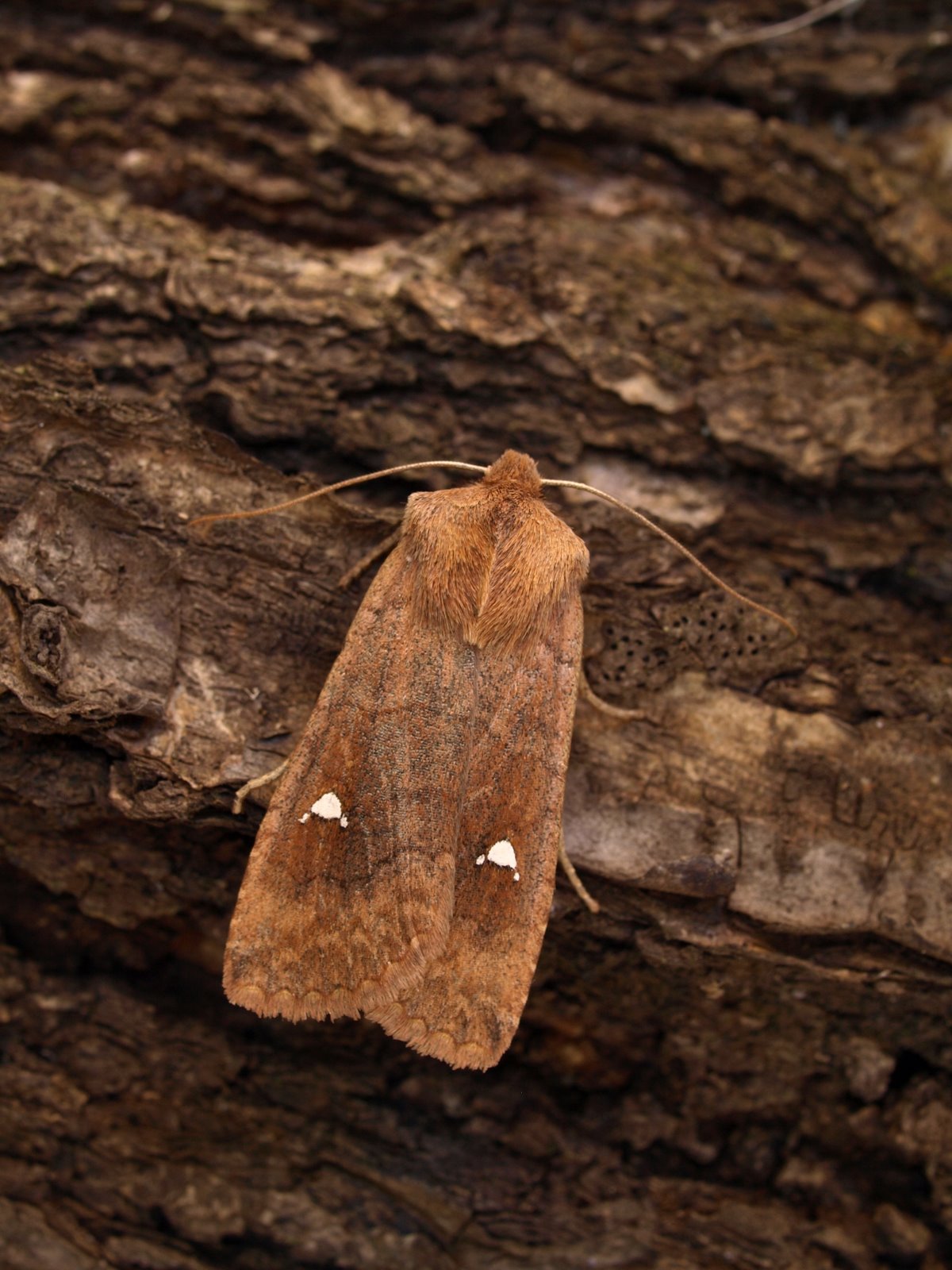
| Sword-grass (Xylena exsoleta) Szürke fabagoly |
Since arriving in Hungary on 11th March I had noticed a few spring geometrids around the windows and settled on white-washed walls. The weather has been sunny but still with a chill in the air and cold at night and the vegetation is looking mostly quite wintry even on our S facing slope. On the 14th though a milder evening brought a large noctuid to the kitchen window at about 9pm . This was fairly easily enticed into the house and captured as it circled the lamp. It was the Satellite (Eupsilia transversa Rozsdabarna Télibagoly) awoken from its winter sleep. Half an hour later I came into the kitchen to find J in the act of catching another moth at the window - she had trumped me with this splendid beast - it dwarfed the Satellite and looked most impressive with its wings spread in the confines of the flat.
The Geometrids seen this week were as follows:
Theria rupicapraria Tavaszi kökényaraszoló
Agriopis marginaria Dotted Border (Aranysárga téliaraszoló)
Alsophila aescularia March Moth (Vadgesztenye-araszoló)
Tuesday, 6 December 2011
26th June 2009 - the Nine-spotted
I wasn't in Hungary during June or the first half of July - too hot - for another 4 years after the first sighting of that Burnet-like moth. During these 4 years I had become increasingly interested in moths. So when I arrived in Miskolc in late June 2009 this time I recognised it from an illustration I had seen - the striking, day-flying moth which seemed to be everywhere, in numbers, in woods and gardens, crawling and sprawling over shrubs and window frames... It was the Nine-spotted (Amata phegea, Fehérpettyes álcsüngőlepke) - known to British lepidopterists as the only member of its family, the Ctenuchidae, on the British list.
The Nine-spotted has been recorded just twice in the UK (and even these records have been doubted) - as a rare immigrant - but for this reason is illustrated in our guide books. Even in Hungary , this moth must be regarded as a special taste of the south. According to Waring and Townsend (2003) the Ctenuchidae is a family of some 3000 species mostly tropical in distribution with very few species found wild in Europe . This species is said to be 'local' in southern Europe . One of the ecological themes of the Bükk hills in northeastern Hungary is the mingling of central- and southern- European species in the rich semi-natural habitats of south-facing limestone slopes.
Incidentally, the superficial resemblance of the moth to the poisonous Zygaenidae (Burnets and Foresters) is an example of mimicry, but whether Batesian or Mullerian I do not know for I do not know if the Nine-spotted is palatable or not.
Monday, 5 December 2011
11th July 2005 - the 1st one
This is the first moth I saw on my first visit to Hungary on my first ever walk in the Hungarian woods with Dani & Benedek. An impressive spotted beast with orange banding and a velvety black body. I didn't know what it was and the rather disappointing photograph I took didn't help me figure it out after I had got home. I guessed it was perhaps some sort of Zygaenid but not one we had in northwest Europe . I was wrong on both counts.
Subscribe to:
Posts (Atom)